Evaluation of the green architecture of the CAP Strategic Plans
- Evaluation
- Environment
- Climate and Climate Change
- CAP Strategic Plans
- Green Deal Targets
- Sustainability
- Evaluation
- Evaluation Methods
- Evaluation Processes
- Evaluation Practices
The guidelines for assessing the green architecture of CAP Strategic Plans emphasise evaluating the combined effects and contradictions across the various instruments designed to address the CAP's environmental and climate objectives.
- Programming period: 2023-2027
- Environmental impacts

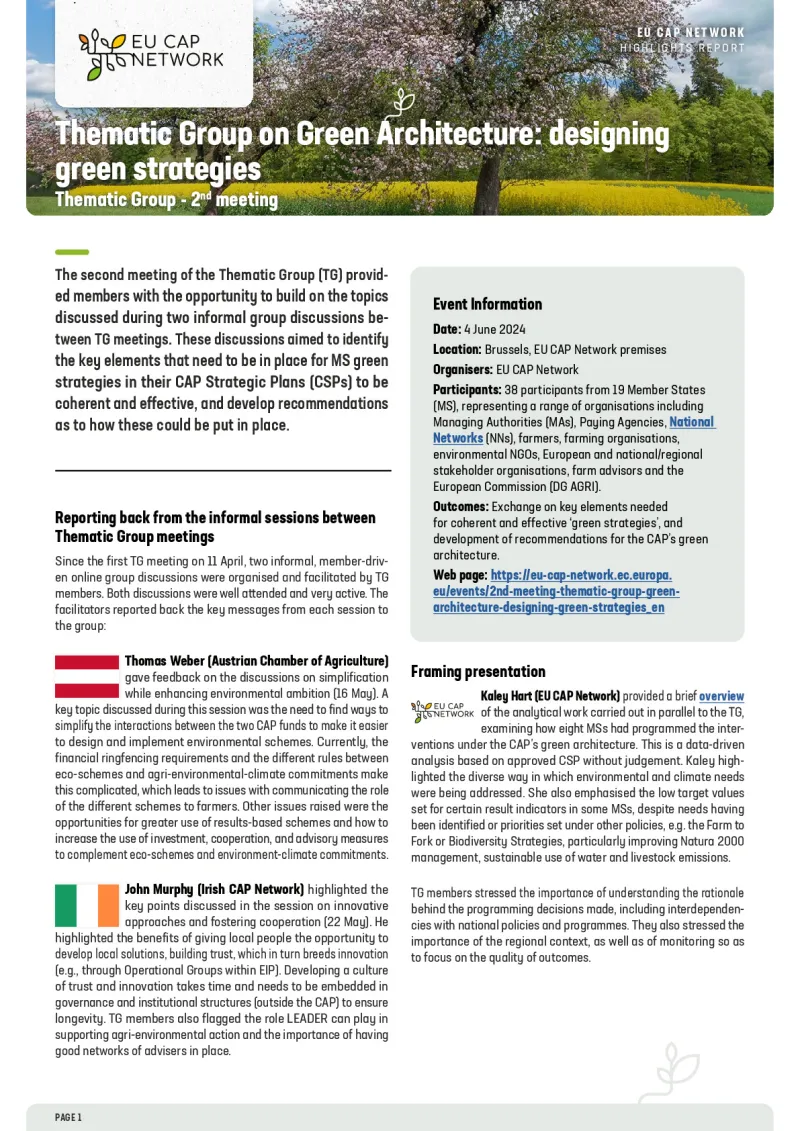
This comprehensive set of guidelines was developed during the thematic working group on the 'Evaluation of environment and climate architecture' organised by the EU CAP Network with the support of the European Evaluation Helpdesk for the CAP between March and December 2025. The main objective of this thematic working group was to provide guidance for Managing Authorities (MAs) and evaluators on how to assess the performance of the green architecture at the Member State level in relation to the evaluation criteria of coherence, effectiveness and efficiency.
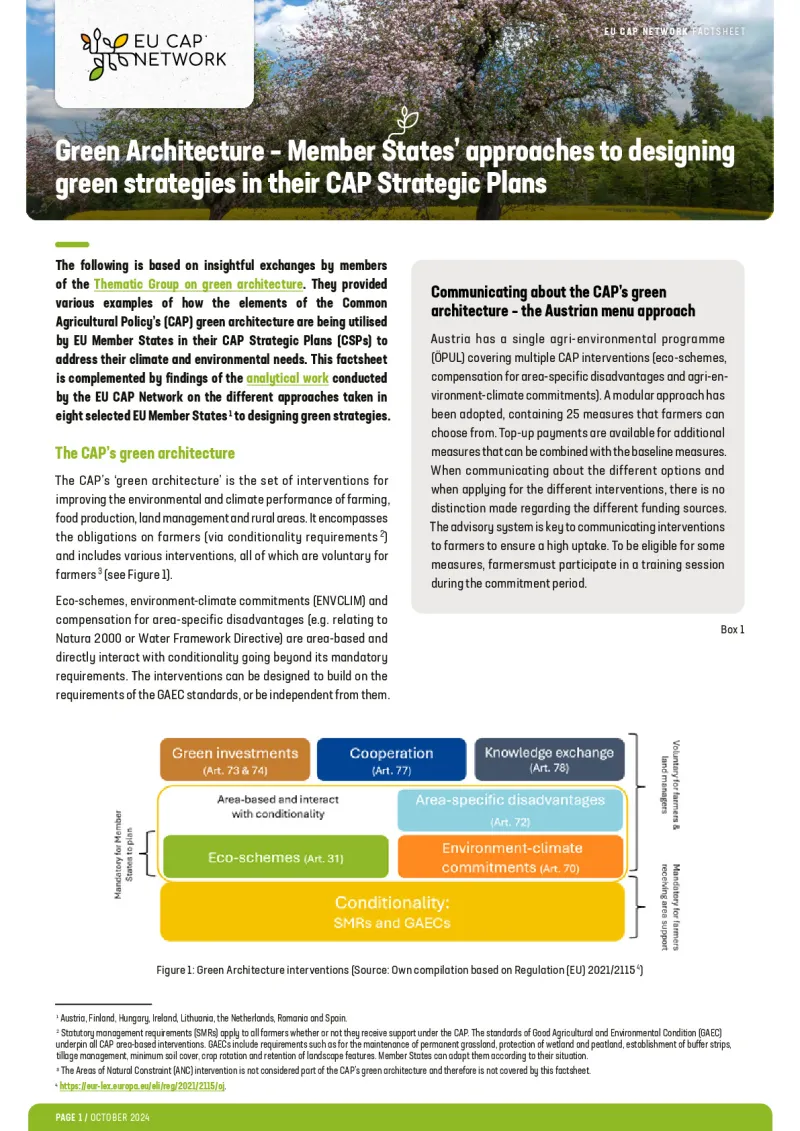
The green architecture refers to the suite of interventions and instruments designed by Member States to achieve the CAP’s environmental and climate objectives, specifically those articulated in Specific Objectives (SO) 4 (climate action), SO5 (natural resources) and SO6 (biodiversity). The guidelines are intended to support MAs and evaluators in assessing how these instruments, when used in combination, contribute to environmental and climate goals, and how their interplay can be optimised for greater policy impact.
The experts participating in the thematic working group recognised that there is no uniform design of green architecture across Member States, nor a single prescribed method for evaluating its performance. Each Member State has considerable flexibility in selecting and combining CAP instruments, such as good agricultural and environmental conditions (GAECs), eco-schemes, agri-environment-climate measures (AECMs), sectoral interventions and several others, to address their unique environmental and climate challenges.

The evaluation framework proposed in the guidelines is structured around three core criteria: effectiveness, coherence and efficiency. Effectiveness concerns the extent to which the green architecture, as a bundle of instruments, achieves the intended environmental and climate outcomes. Coherence examines how well the instruments work together internally (within the green architecture), with other CAP interventions and with external EU and national environmental legislation. Efficiency assesses whether the outcomes are achieved at a reasonable cost, considering both direct support to beneficiaries and administrative burdens on both authorities and farmers.
A key conclusion of the guidelines is that a robust evaluation of green architecture must go beyond assessing individual objectives or instruments. Instead, it should adopt a holistic approach that captures the interplay between interventions, identifies synergies and trade-offs, and considers the broader policy context, including links to other EU environmental legislation such as the Water Framework Directive, Habitats and Birds Directives, and the EU Climate Law. The guidelines provide detailed methodological advice, including the use of intervention logic models, indicator selection and data use.
The guidelines also highlight the importance of timing and sequencing in evaluations. They recommend that green architecture evaluations be conducted toward the end of the programming period, when sufficient implementation data are available, and also note the value of earlier evaluations for informing future policy adjustments. The document encourages a 'pick-and-mix' approach, allowing MAs and evaluators to tailor the scope and depth of their assessments to national circumstances and available resources.
The principal conclusion is that the effectiveness of the CAP’s green architecture depends not only on the design and implementation of individual instruments, but more importantly on their combined and coherent application. Evaluations should therefore focus on the system-level performance of the green architecture, examining how instruments interact to deliver environmental and climate benefits, and how these interactions can be optimised for greater impact and efficiency. The guidelines provide a flexible framework for such evaluations, aiming to support continuous policy learning and improvement and, ultimately, to enhance the CAP's contribution to the EU’s environmental and climate ambitions.
Author(s)
European Evaluation Helpdesk for the CAP