Thematic Group on the Design and Implementation of Eco-schemes in the new CAP Strategic Plans
This Thematic Group brought together Member State representatives, farming organisations, advisors, farmers, non-governmental organisations and researchers to discuss progress with the implementation of eco-schemes.
Context

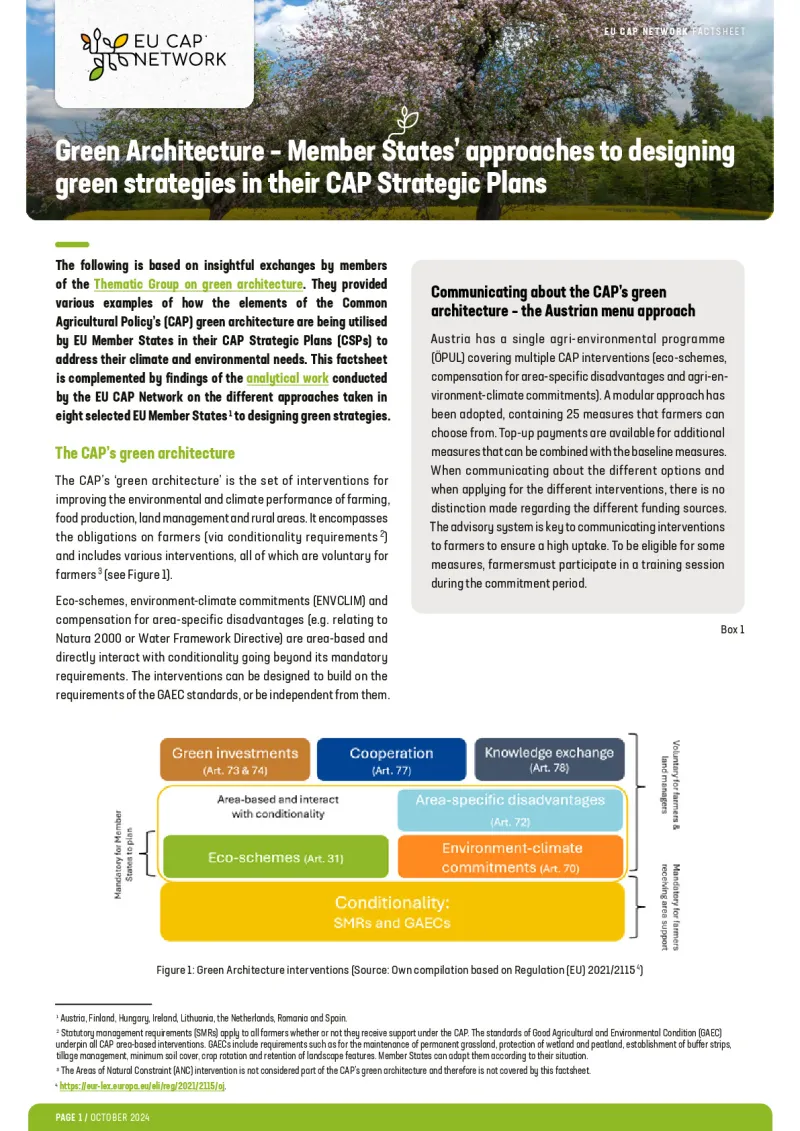
Eco-schemes are an important ‘building block’ of the CAP’s Green Architecture, which includes a wide range of tools to improve the environmental and climate performance of agricultural activities. It is therefore important that eco-schemes are assessed while considering their interlinkages with the full range of Green Architecture tools, including agri-environment-climate commitments, investments, support to organic farming, and other relevant interventions.
When the Thematic Group (TG) started in October 2023, the implementation of eco-schemes was in its early stages, as the CAP Strategic Plans (CSPs) came into force in January 2023. Therefore, this was a good moment to reflect on the range of eco-schemes currently being implemented and share experiences on levels of farmer engagement, what is working well and where improvements might be made for coming years.
This TG provided an opportunity to bring Member State representatives such as Managing Authorities (MAs), National Networks (NNs), Paying Agencies (PAs), farming organisations, advisors, farmers, non-governmental organisations and researchers together to discuss progress with the implementation of eco-schemes up until early 2024.
Objectives
The objectives of this TG were to:
- Share experiences on the different approaches to the design of eco-schemes in terms of the environmental objectives that have been prioritised;
- Explore the relative merits of the approaches taken and whether there are lessons to be learned for the future;
- Explore issues relating to implementation, particularly how eco-schemes have been promoted and how farmers have reacted to their introduction, to identify success stories as well as challenges and common issues faced, and how to overcome these;
- Develop ideas and recommendations for improvements that could be made toward both eco-scheme design and/or implementation in future years.
Activities
The first TG meeting (25/10/2023) focused on exchanging experiences on the design and implementation of eco-schemes across Member states and their interaction with other parts of the Green Architecture. It also identified what is working well and what issues are arising in terms of uptake while sharing lessons learnt from the first year of the implementation of eco-schemes. A highlights report summarises the key findings of the first meeting.
The second TG meeting (20/02/2024) built on continuing sharing insights on good practices on eco-schemes and went into details considering certain elements of the Green Architecture e.g. administrative issues (controls, payments, application procedures, raising awareness, and targeting/regionalising eco-schemes. Furthermore, TG members developed ideas and recommendations for improvement that could be made in future years to secure widespread adoption of sustainable farming practices in the EU. A highlights report summarises the key findings of the second meeting.
Informal online exchanges took place between the two formal TG meetings and allowed for further discussion among the TG members and the exchange of experiences and good practices.
The TG produced a series of outputs that are presented in the Related Publications section further down on this page.
Key findings
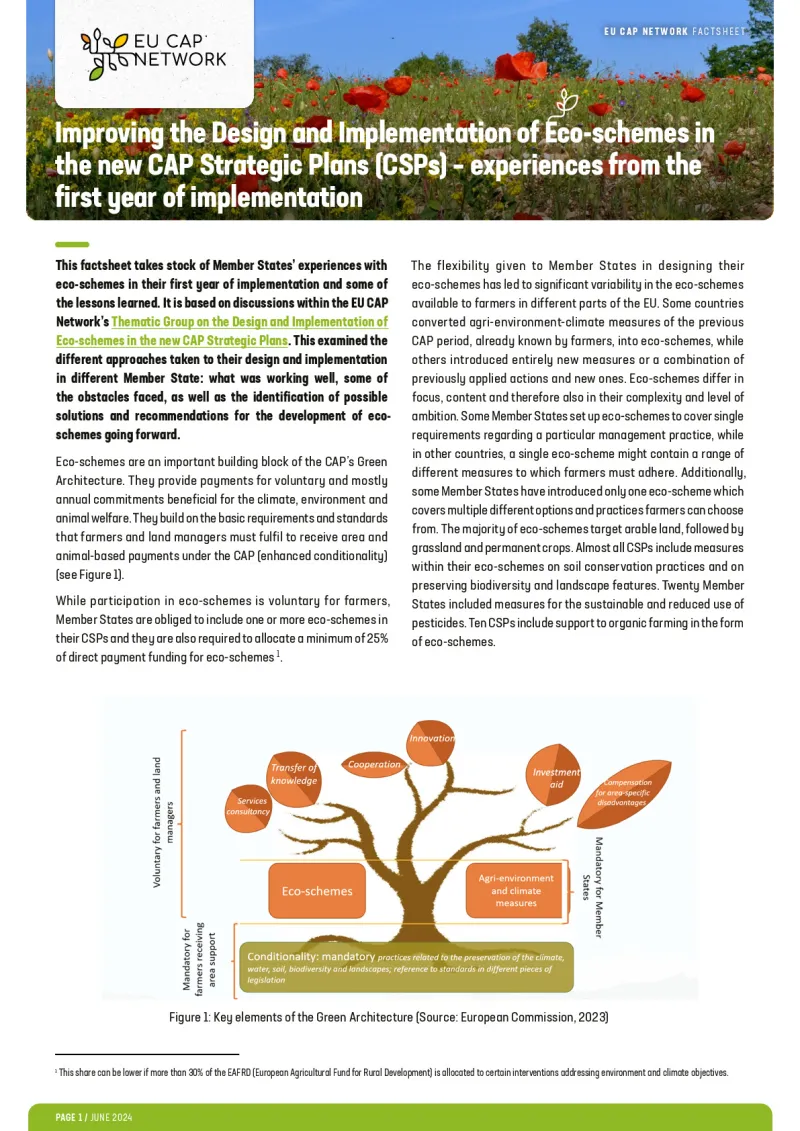
The TG work fed into a final Factsheet which discusses lessons learnt from the first year of CAP implementation relating to:
- The importance of raising farmers’ awareness of eco-schemes;
- The administrative processes linked to their implementation, including financial management;
- How they are designed and targeted, including the practices chosen;
- How they fit with other parts of the Green Architecture.
The Factsheet presented a series of recommendations that the European Commission or the Managing Authorities, or both, can consider to improve the design and implementation of eco-schemes. The recommendations include:
- Improving the sharing of information between different actors such as managing authorities, regional authorities, municipalities, farmers associations, NGOs and advisors, and strengthen agricultural knowledge and innovation systems (AKIS);
- Putting structures in place to encourage the eco-scheme co-design with farmers, while involving other relevant stakeholders;
- Facilitating the sharing of best practices between Member States, especially regarding the use of digital tools.
Learn more
Scroll down this page to find all the outputs of this Thematic Group and relevant resources related to this topic.
You can find other useful resources about this theme in our Publications section and in our Good Practice database.
If you have any questions or suggestions, please contact us at implementation@eucapnetwork.eu.
If you want to be informed when new content is available on this or related topics, subscribe to the EU CAP Network newsletter.