Bridging the gap: CAP in the real world
Thematic Groups convene to address real-world challenges facing European farmers and rural communities, involving a variety of CAP stakeholders from across the EU, and connecting policy and practice.

Page contents
Every year, the EU CAP Network, supported by the CAP Implementation Contact Point, convenes five Thematic Groups (TGs). Each group gathers approximately 40 CAP stakeholders, selected through a public expression of interest, which attracts a high number of applicants across the EU. In a nutshell, TG members then set to work, both to exchange knowledge to illuminate how CAP policy functions on the ground, and to translate abstract policy goals into grounded, practical solutions. Plenty of variety in participant profiles, the opportunity to provide real-time EU and national policy feedback, and learning about optimal approaches for putting policy in practice are among the benefits, according to TG members.
Strength in diversity
“The heterogeneity of the participants is particularly useful,” says Professor Dr Felix Arion, Director of the Department of Economic Sciences at the University of Agricultural Sciences and Veterinary Medicine Cluj-Napoca in Romania, and one of the experts involved in the TG on the Economic Vulnerability of Farming. “Our group was a diverse mix of practitioners and innovators from across 21 EU Member States, including farmers, cooperatives, advisors, researchers, food processors, retailers, NGOs, and other stakeholders. In this instance, this diversity provided a comprehensive perspective on agri-logistics challenges and opportunities, facilitating networking and cross-learning on a European scale.”
Conceived as both time-bound and outcome-focused, TGs convene to address real-world challenges facing European farmers, such as administrative burdens, supporting biodiversity, fostering generational renewal, or navigating economic vulnerabilities. Topics are defined based on the EU CAP Network’s Annual Work Programme and usually fall under one or more of the CAP’s three General Objectives: (i) fostering a smart, competitive, resilient agricultural sector with long-term food security; (ii) advancing environmental protection and climate action, including biodiversity; and (iii) strengthening the socioeconomic fabric of rural communities.
TG discussions can help find tailored solutions to common problems. “The TG helped me realise that the problems that I had figured out in France by working with NGOs and public institutions were pretty common across the EU, meaning that collective proposals can help us move forward, united,” says Clémence Morant, a member of the TG Gen Z: Leading Generational Renewal in Farming. While a group can work to inform EU policies, members can also gain insights from colleagues from other countries and backgrounds and bring them “back to our countries to continue boosting our respective networks there, more locally, more concretely.”

Informing EU and national policy development
Some of the TGs tackle topics (simplification, generational renewal, green architecture, economic vulnerability of farming) pertinent to ongoing policy development at the European level, with outputs aimed at informing the design of such policies. To take one example, in May 2025, the European Commission proposed legislative change to simplify the CAP, an aspect that was referenced in its vision for agriculture and food. The TG on Effective Approaches for Simplification within the CAP focused on the practical challenges in delivering CAP Strategic Plans (CSPs) and potential solutions.
TG member Katarina Carthew, analyst in the Rural Analysis Unit at the Swedish Board of Agriculture, explains: “When policy is put into practice, it is important to understand how one policy relates to and interacts with other policies, and look at it from the perspective of the beneficiary. To not overburden beneficiaries requires streamlining various policies and legislations on an EU-level and clear communication and collaboration between authorities on a national level.”
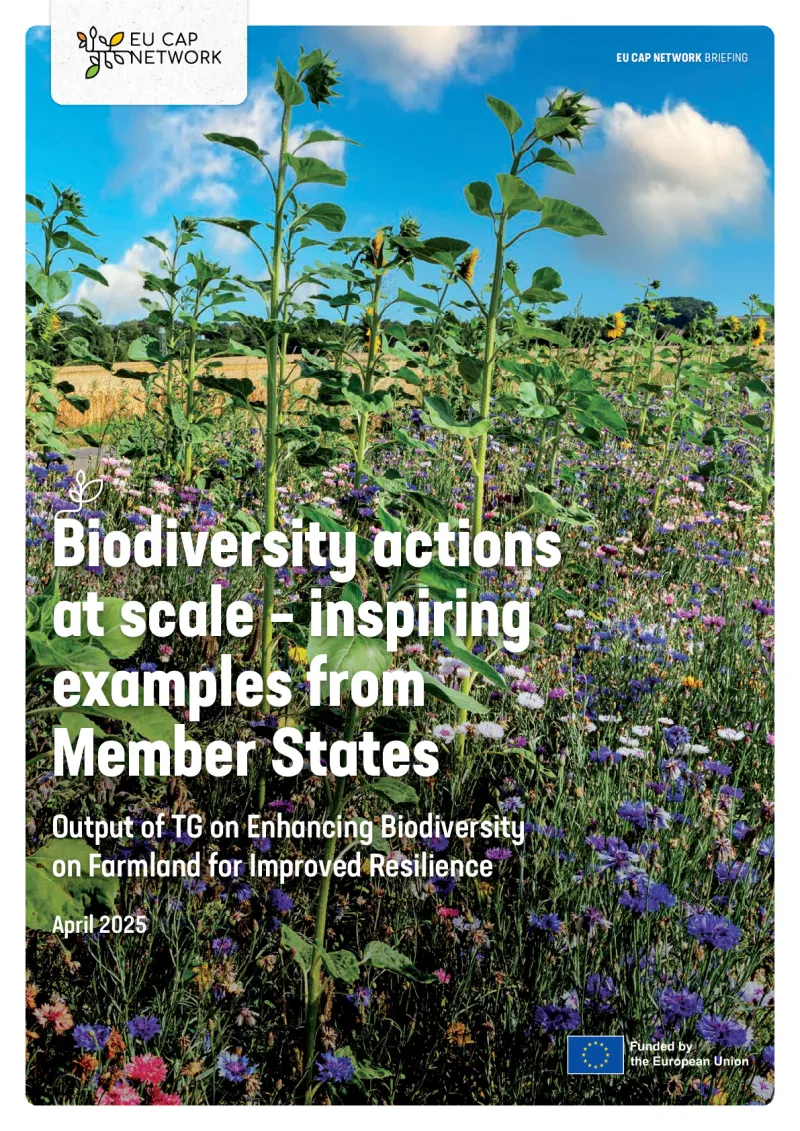
Other TGs, such as the TG on Enhancing Biodiversity on Farmland for Improved Resilience (check out the background paper here), focus more on national-level policy delivery as practitioners prepare for ensuring healthy ecosystems and nature-friendly farming in line with the recent Nature Restoration Regulation. According to TG participant Tatiana Nemcova, senior agriculture policy officer with Birdlife (Europe and Central Asia), there was consensus among the diverse stakeholders in the TG on what is needed for better biodiversity on farmland.
“There was broad recognition of the need to increase funding for biodiversity actions and to ensure that payments are attractive enough for farmers to participate. The value of biodiversity conservation also needs to be communicated more effectively to farmers, which is closely linked to the need for improved monitoring. And, last but not least, and very importantly, farmers should receive stronger support from advisory services and managing authorities in taking action for biodiversity,” says Nemcova.
Participation in a TG can also be a catalyst for deep personal and professional development. For Morant, the experience with TG Gen Z was part of a profound realisation that “if I wanted to have a concrete impact beyond reports and presentations, I needed to switch to the other side of the science-policy interface” – which led her to apply for a role in local policymaking in the French overseas administration. “It is challenging, but seeing the tangible impact my dedication can have on public policies for local food sovereignty integrated with respect for our environment is very rewarding”.

Optimal approaches for putting policy into practice
Anton Gazenbeek, from Eurosite-ELCN in Belgium, also joined the TG on Biodiversity. He comments: “Because the group predominantly consisted of practitioners (whether farmers, agricultural advisers, agriculture ministry officials or hands-on conservationists), a lot of information came up on how abstract policies are concretely implemented in different country contexts, and how this implementation is perceived by the final recipient-stakeholders. This is invaluable, and highlights ways to make policy implementation both more effective and more supported by those at the receiving end who actually have to carry it out.” Highlights and outputs, including policy recommendations co-created by TG members, are available here.
Lukas Oßberger, Austrian Chamber of Agriculture, similarly cited insights into how different methods of implementing policy can greatly impact its acceptance – but in relation to another TG topic: economic vulnerability of farming, a central concern for many farming sectors across the EU. “Learning about the factors considered most relevant by other European states in the context of economic vulnerability and their preferred instruments for mitigating it provided me with fresh insights,” says Oßberger.

Based in Brussels, Niccoló Ciulli, Adviser, Competitiveness and Commercial Relations at EuroCommerce, also participated in the TGs on the Economic Vulnerability of Farming. He saw the group as an opportunity to showcase good examples of cooperation agreements between retailers and farmers to mitigate challenges such as climate change, sufficient income and the sustainability transition. For Ciulli, the TG served to address a crucial knowledge gap: “As retailers, we of course have a good understanding of what consumers are seeking, our relations with the farmers, how contract/negotiations work, etc. Day to day, we tend to have less visibility of all the various projects farmers are undertaking on-farm, for example, in relation to risk assessment/risk management, farm-to-farm best practice exchange, the use of technology and how all this fits with the CAP. The TG really filled out the picture for me.”
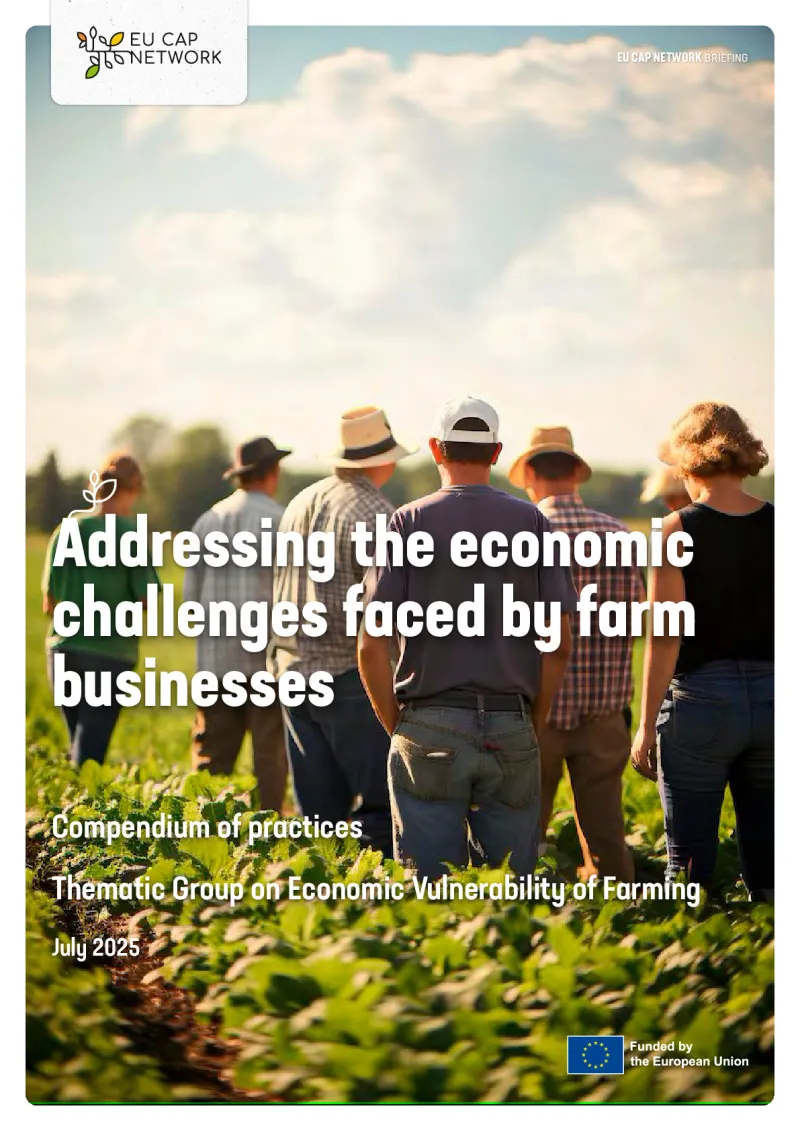
Published outputs from the group are ensuring that this exchange not only continues, but also reaches a wider audience. This compendium presents a selection of the various ways that the economic challenges faced by farm businesses can be addressed, with solutions identified by the TG on Economic Vulnerability of Farming.